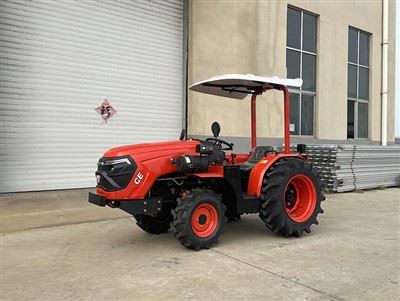


The Suth 504S is a high-performance, cost-effective model designed for working environments that are not too harsh and require a large amount of horsepower.
Features include a hydraulically adjustable 3-point suspension, two hydraulic output systems, a flat floor, a spring-loaded seat, a spacious and comfortable operating area for the driver, and an 8F+8R shuttle shifter.
Specs.
|
KEY SPECS |
|
POWER TAKE-OFF (PTO) |
|
|
Engine power (gross) |
36.8KW (50hp) |
Standard |
540/720 rpm |
|
Power take-off (PTO) power |
28.8KW (39hp) |
||
|
Steering hydraulics |
24 L/min |
||
|
Implement hydraulics |
38.4 L/min |
TRANSMISSION |
|
|
Remote control valves available |
Standard: Two pairs |
Standard transmission; forward/reverse |
8F / 8R |
|
Pump type |
Gear pump |
||
|
Hitch type |
Cat. 1 |
||
|
Lift capacity, 24-in. behind link arms |
950 kg |
Rollover protective structure |
Yes |
|
Approximate shipping weight |
Open station: 1550 kg |
Platform - flat/straddle |
flat |
|
Wheelbase |
1810 mm |
||
|
Fuel tank capacity |
120 L |
ENGINE |
|
|
Battery size |
80A |
Manufacturer |
LAIDONG |
|
Alternator (14-V) |
350W |
Engine model |
KM495BT |
|
Brakes |
Drum brake |
Engine power (gross) |
36.8KW (50hp) |
|
Steering |
Hydraulic steering |
Rated engine speed |
2400 rpm |
|
Axle capacity |
Front 800 kg; Rear 1800 kg |
Injection pump type |
Direct Injection |
|
Front tread spacing |
1040, 1100, 1200, 1300 mm |
Aspiration |
Natural |
|
Rear tread spacing |
1100 - 1300 mm |
Emissions compliance |
2 stage |
|
Turning radius with brakes |
3 m |
Number of cylinders |
Four |
|
Dimensions |
3500x1500x2200 mm, |
Displacement |
2.836 L |
|
|
|||
|
TIRES |
Toolbox |
Yes |
|
|
Front Rear |
7.50-16 11.2-28 |
Differential lock |
Yes |
|
Air Brake |
Optional |
||
|
Swing traction |
Optional |
Details


How to Break in a Tractor After Overhaul
A tractor that has undergone overhaul needs to be broken in (test run) before use. This is because newly fitted or repaired parts often have machining marks on their surfaces, and the assembled components may not fit perfectly. Immediate use can easily cause accelerated wear or scratches on the friction surfaces of the parts, quickly deteriorating their technical condition. Breaking in allows the friction surfaces to gradually become smooth under minimal wear conditions, extending the machine's lifespan. Simultaneously, break-in allows for further inspection of the repair quality and enables necessary adjustments and treatments. Break-in generally involves four steps:
1. Cold Break-in without Compression: The engine is driven by an electric motor with a transmission mechanism. Break in at 400-500 rpm for 20 minutes; 800-900 rpm for 20 minutes; 1000-1200 rpm for 20 minutes, for a total of 1 hour. If the electric motor does not have a transmission mechanism, break in continuously at around 1000 rpm for 1 hour, using this speed to select the appropriate pulley for the electric motor.
Before break-in, add lubricating oil and coolant. 1. For cold break-in, the lubricating oil is generally less viscous than that used during normal operation; No. 20 engine oil can be used. During break-in, pay attention to whether the oil pressure is normal; whether the valve rocker arm shaft is lubricated; and whether all rotations are flexible. For cold break-in without compression, the fuel injector should be removed.
2. For cold break-in with compression, run the engine at full compression for 20 minutes at 600-800 rpm; then for 20 minutes at 1000-1200 rpm, for a total of 40 minutes. After cold break-in with compression, change the lubricating oil and carefully check for metal shavings, water droplets, and other impurities. Also, carefully check for leaks of water, oil, and air.
3. For hot break-in without load, start the engine and run at 700-800 rpm for 5 minutes; then at 1000-1100 rpm for 20 minutes; finally, run at rated speed for 5 minutes, for a total of 30 minutes.
4. The break-in load refers to the power output of the engine at its rated speed, which needs to be measured using a dynamometer. The engine is broken in at 1/4 load for 10 minutes; 1/2 load for 20 minutes; 3/4 load for 20 minutes; and full load for 5 minutes, for a total of 55 minutes. During the break-in process, it is important to check whether the oil pressure, oil temperature, coolant temperature, and diesel pressure are within normal values. If they are not normal, it indicates that the locomotive still has certain problems and requires further adjustment. If the power is insufficient or other faults occur, it must be repaired.
After the break-in, the following should also be done:
1. While still hot, drain the gear oil from the gearbox, rear axle, and final drive case, inject diesel fuel for cleaning, then drain the diesel fuel, remove iron filings from the oil plugs and magnet, and replace with new gear oil.
2. While still hot, drain the engine oil from the oil pan, clean the lubrication system with diesel fuel, and replace with new engine oil.
3. 1. Drain the engine oil from the starter transmission mechanism, steering gear housing, and hydraulic oil tank. Clean these components with diesel fuel and then replace the oil with new oil.
2. Add lubricating oil to the fuel injection pump, governor, and all lubrication points according to the lubrication schedule.
3. Check and adjust valve clearances, and tighten cylinder head bolts.
4. Clean the air filter screen with diesel fuel and replace the engine oil in the oil pan.
5. Check and adjust clutch and brake clearances, eliminate any leaks of water, oil, or air, and thoroughly check and tighten all bolts.
Hot Tags: 50hp tractor with special offer, China 50hp tractor with special offer manufacturers, suppliers, factory, tractor farm equipment, mini tractor 24hp, 50 HP tractor A C cabin, tractor for agriculture, tractors machinery implements, 50hp Greenhouse Tractor