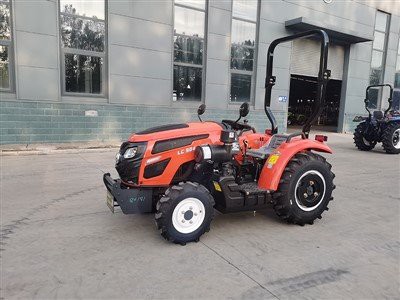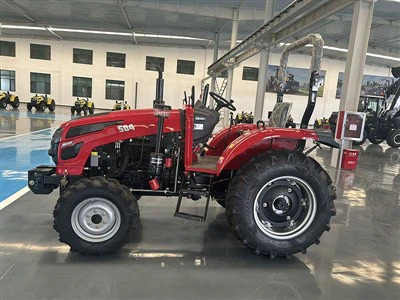



The Suth 504 is a very popular tractor with the highest sales volume and the widest user base. It can be equipped with 8F+8R, tilting traction, large tires, and a flat floor. It is a very practical model that can be customized according to the needs of farmers..
Advantages
I. Upgraded chassis, compact structure, allowing the tractor to navigate narrow roads.
II. Small turning radius, enabling the tractor to work quickly in confined farmland.
III. High ground clearance and large tire diameter result in high speed and the ability to tow small to medium-sized trailers.
|
KEY SPECS |
|
POWER TAKE-OFF (PTO) |
|
|
Engine power (gross) |
36.8KW |
Standard |
540/720 rpm |
|
Power take-off (PTO) power |
28.8KW |
Optional |
540/1000 rpm |
|
Steering hydraulics |
24 L/min |
||
|
Implement hydraulics |
38.4 L/min |
TRANSMISSION |
|
|
Remote control valves available |
Standard: One pair |
Standard transmission; forward/reverse |
8F / 2R |
|
Pump type |
Gear pump |
Optional transmission; forward/reverse |
8F / 8R |
|
Hitch type |
Category 1 |
||
|
Lift capacity, 24-in. behind link arms |
1150 kg |
Rollover protective structure |
Yes |
|
Approximate shipping weight (open-station; cab) |
Open station: 1750 kg |
Platform - flat/straddle |
Semi-flat, flat, sealed flat(Cab) |
|
Wheelbase |
1810 mm |
||
|
Fuel tank capacity |
60 L |
CAB |
|
|
Battery size |
80A |
Visibility |
Rear camera |
|
Alternator (14-V) |
350W |
Air conditioning, temperature differential |
16°C |
|
Brakes |
Drum brake |
Doors |
Two |
|
Steering |
Hydraulic steering |
Seat equipment |
Air suspension |
|
Axle capacity |
Front 800 kg; Rear 1800 kg |
||
|
Front tread spacing |
1040, 1100, 1200, 1300 mm |
ENGINE |
|
|
Rear tread spacing |
1100 - 1300 mm |
Manufacturer |
LAIDONG |
|
Turning radius with brakes |
3 m |
Engine model |
KM495BT |
|
Dimensions |
3500x1500x2200 mm, 3500x1500x2500 mm (Cab) |
Engine power (gross) |
36.8KW |
|
|
Rated engine speed |
2400 rpm |
|
|
TIRES |
Injection pump type |
Direct Injection |
|
|
Front |
6.00-16 |
Aspiration |
Natural |
|
Emissions compliance |
2 stage |
||
|
Number of cylinders |
Four |
||
|
Displacement |
2.836 L |
||
|
Toolbox |
Yes |
||
|
Differential lock |
Yes |
||
|
Air Brake |
Optional |
||
|
Rear |
9.5-24 |
Swing traction |
Optional |
|
|
Details


Workshop


Packaging and Delivery


Factory

Rotary Tiller Selection and Use
1. Selection Points
● Reasonable Matching: The rotary tiller's power consumption should be lower than the output power of the matching tractor. The working width of the rotary tiller should be able to cover the left and right wheel tracks of the matching tractor. A three-point suspension rotary tiller, when matched with the tractor, should have little impact on the force distribution on the front and rear wheels of the tractor.
● Safety and Reliability: The rotating parts of the rotary tiller should have safety guards, and the guards should be sturdy. The rotary tiller should be able to stand stably when placed alone and should not tip over without external force. The rotary tiller should ideally have safety warning signs on its casing and should be accompanied by a complete and clear instruction manual, including technical specifications, safety precautions, correct assembly and operation instructions or appropriate diagrams, adjustment methods and adjustment ranges, maintenance and upkeep instructions, and troubleshooting methods for common malfunctions.
● Meeting Local Agricultural Requirements: The tillage depth should meet the requirements for rice or other crops. Generally, the tillage depth of a rotary tiller should not be less than 10cm.
● Good After-Sales Service: The place of purchase should have repair and spare parts sales services. A "three guarantees" service card (repair, replacement, and return) must be provided upon purchase, and the after-sales service commitment should comply with the regulations of the "Responsibility for Repair, Replacement, and Return of Agricultural Machinery Products."
● Try to choose rotary tillers that have obtained the Ministry of Agriculture's Agricultural Machinery Promotion License and bear the Ministry of Agriculture's Agricultural Machinery Promotion License stamp.
**Precautions for Use**
The working characteristic of a rotary tiller is that its working parts rotate at high speed, and almost all safety issues are related to this. Therefore, pay attention to the following points when using a rotary tiller:
● Before use, check all parts, especially whether the rotary blades are installed backwards and whether the fixing bolts and universal joint locking pins are secure. Address any problems promptly, and only use the machine after confirming everything is secure.
● Before starting the tractor, the rotary tiller clutch handle should be moved to the disengaged position.
● Engage power while the tractor is in the raised position. Once the rotary tiller reaches the predetermined speed, the unit can start moving, and the rotary tiller should be slowly lowered to allow the rotary blades to enter the soil. It is strictly forbidden to start the rotary tiller directly with the blades in the soil to prevent damage to the blades and related components. Rapidly lowering the rotary tiller is strictly prohibited. Reversing and turning are strictly prohibited after the blades have entered the soil.
● When turning at the end of a field without disengaging power, the rotary tiller must not be raised too high, and the transmission angle at both ends of the universal joint must not exceed 30 degrees. The engine speed should also be appropriately reduced. When moving to a different plot of land or traveling a long distance, the power to the rotary tiller must be disengaged, and the tiller must be raised to its highest position and locked.
● When the rotary tiller is running, people are strictly prohibited from approaching rotating parts, and no one should be behind the tiller to prevent injury in case the blades are flung out.
● When inspecting the rotary tiller, the power must be disengaged first. When replacing blades or other rotating parts, the tractor must be turned off.
● The recommended forward speed for tilling is 2-3 km/h for dry fields, 5-7 km/h for already plowed or harrowed fields, and slightly faster for paddy fields. Remember, the speed must not be too high to prevent overloading the tractor and damaging the power take-off shaft. ● When the rotary tiller is working, the tractor wheels should travel on uncultivated ground to avoid compacting already cultivated land. Therefore, the tractor's wheelbase needs to be adjusted so that the wheels are within the working width of the rotary tiller. Pay attention to the walking method during operation to prevent the other wheel of the tractor from compacting the cultivated land.
● During operation, if the cutter shaft becomes excessively entangled in weeds, stop the machine immediately to clear the weeds and avoid increasing the load on the implements.
● No one is allowed to ride on the tractor or in the suspension area while rotary tilling to prevent accidental injury from the rotary tiller.
● When using a walking tractor rotary tiller unit, the rotary tilling gear can only be engaged when the secondary gear lever is in the "slow" position. If reversing is required, the secondary gear lever must be in neutral before engaging reverse. Avoid using the steering clutch during rotary tilling; use the push or pull handlebars to correct the direction. When turning at the end of a field, first reduce the throttle, lift the handlebars, and then engage the steering clutch. Avoid sharp turns to prevent damage to parts.
Rotary tiller maintenance is divided into shift maintenance and quarterly maintenance. Generally, shift maintenance should be performed after each shift, including: checking and tightening connecting bolts; checking for damage to easily worn parts such as pins and cotter pins, replacing them if necessary; checking the transmission box, crossbars, and bearings for insufficient lubrication, replenishing it immediately if necessary. Quarterly maintenance should be performed after each quarter of operation, including: thoroughly cleaning mud, dust, and oil stains from the implements; completely replacing the lubricating oil and grease; checking for excessive wear on the blades, replacing them if necessary; checking for deformation of the hood, trailer, etc., restoring them to their original shape or replacing them; comprehensively inspecting the appearance of the implements, touching up the paint, and applying rust-preventive oil to the curved blades and splined shafts; when not in use for extended periods, rotary tillers paired with wheeled tractors should be placed on a level surface and should not be suspended from the tractor.
Hot Tags: 50hp tractor suth 504 with flat floor, China 50hp tractor suth 504 with flat floor manufacturers, suppliers, factory, tractor farm equipment, mini tractor 24hp, 50 HP tractor A C cabin, tractor for agriculture, tractors machinery implements, 50hp Greenhouse Tractor