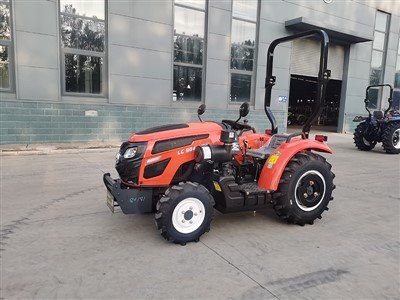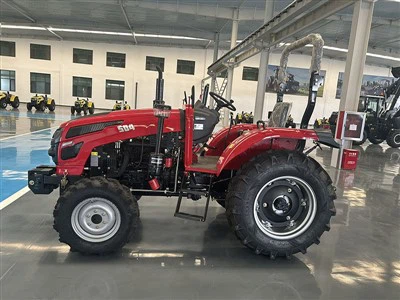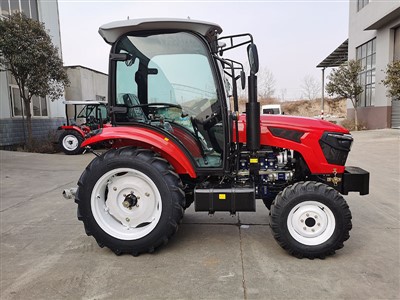



The SUTH 2404 is a powerful 240-horsepower tractor with a reinforced chassis, a Carraro front axle, an electro-hydraulic system, front PTO, front 3PT, and a variety of optional features to ensure it can meet the needs of various working environments.
Advantages
I. It uses a renowned Shangchai six-cylinder diesel engine, providing ample power and a large torque reserve. The Carraro front axle and LUK clutch contribute to its high body strength.
II. The hydraulic output valve and three-point suspension system with a hydraulic electronic control system make operation more convenient.
III. 16F+16R gear shiftx, hydraulically assisted clutch, and MAXAM radial tires provide excellent traction.
|
KEY SPECS |
|
TRANSMISSION |
|
|
Engine power (gross) |
177KW |
Standard transmission; forward/reverse |
16F / 16R |
|
Power take-off (PTO) power |
155.7KW |
||
|
Steering hydraulics |
38.4 L/min |
ENGINE |
|
|
Implement hydraulics |
79.2 L/min |
Manufacturer |
SHANGCHAI |
|
Remote control valves available |
Standard: Four pairs |
Engine model |
SC7H240G3 |
|
Pump type |
Gear pump |
Engine power (gross) |
177KW |
|
Hitch type |
Category 3 |
Rated engine speed |
2200 rpm |
|
Lift capacity, 24-in. behind link arms |
6000 kg |
Injection pump type |
Common Rail |
|
Approximate shipping weight (open-station; cab) |
9000KG (Cab) |
Aspiration |
Turbocharger |
|
Wheelbase |
2830 mm |
Emissions compliance |
3 stage |
|
Fuel tank capacity |
500 L |
Number of cylinders |
Six |
|
Battery size |
120A x 2 |
Displacement |
6.4 L |
|
Alternator (28-V) |
55A |
Cooling system |
Water pump |
|
Brakes |
Oil brake |
||
|
Steering |
Hydraulic steering |
TIRES |
|
|
Axle capacity |
Front: 4300 kg |
Front |
18.4-26 |
|
Front tread spacing |
1720, 1820, 1980, 2050 mm |
Rear |
20.8-38 |
|
Rear tread spacing |
1700 - 2500 mm |
||
|
Turning radius with brakes |
6 m |
Toolbox |
Yes |
|
Dimensions |
5550x2750x3250 mm (Cab) |
Differential lock |
Yes |
|
|
Front PTO |
Optional |
|
|
CAB |
Front 3PT linkage |
Optional |
|
|
Visibility |
Rear camera |
Electric hydraulic control |
Optional |
|
Air conditioning, temperature differential |
16°C |
Air Brake |
Optional |
|
Doors |
Two |
Quick hitch |
Optional |
|
Seat equipment |
Air suspension |
|
|
|
|
|
||
|
POWER TAKE-OFF (PTO) |
|
||
|
Standard |
540/1000 rpm |
|
|
|
|
|
Details


Workshop


Packaging and Delivery


Factory

Tractor transmission system
The transmission system of a tractor, excluding the power system, hydraulic and auxiliary systems, working devices, and electrical equipment, is its main component. The chassis integrates the engine and all other systems and devices of the tractor, converting the engine's power into the driving force for the tractor to move, ensuring that the tractor can perform field operations, transportation operations, or stationary operations as required.
The tractor transmission system mainly consists of transmission, steering, and braking components.
All transmission components between the engine and the drive wheels are collectively referred to as the transmission system.
The function of a tractor's transmission system is to transmit the engine's power to the drive wheels, enabling the tractor to obtain the required driving speeds and traction, and to achieve the tractor's starting, stopping, and reversing; and to transmit power to the power take-off shaft to drive various agricultural machinery.
Classification of Tractor Transmission Systems
Based on the method of changing the transmission ratio, transmission systems can be divided into stepped and continuously variable transmissions. Based on the way energy is transmitted and transformed, they can be divided into mechanical, hydraulic, and electric transmissions. Mechanical transmissions are commonly used as stepped transmissions, while hydraulic and electric transmissions are continuously variable transmissions.
Composition of the transmission system of a wheeled tractor
Wheeled tractor drivetrains typically consist of a clutch, gearbox, central drive, differential, final drive, and power take-off shaft. Tracked tractors usually have a coupling between the clutch and gearbox, and use a steering mechanism instead of a differential. Some wheeled and tracked tractors have an auxiliary reducer (creeper) or reverser (reverse gear) between the clutch and gearbox or between the gearbox and central drive. The auxiliary reducer may also be located on the side or front of the gearbox. Four-wheel drive tractors require a transfer case. Some transfer cases simply add a few gears to the gearbox, with power to the front axle taken from the gearbox output shaft via the transfer case. Some transfer cases are located on the left side of the gearbox, requiring universal joints at both ends of the driveshaft; others are located below the gearbox. If the driveshaft is positioned directly in the center, with its axis concentric with the front axle rocker shaft, a rigid coupling can be used. Walking tractors often use a transverse shaft gearbox, with belt transmission for the first stage of reduction and a dog clutch as the steering mechanism. The transmission system of a boat-type tractor is very similar to that of a hand-held tractor. The steering mechanism uses either a jaw clutch or a multi-plate steering clutch.
Hot Tags: tractor 240hp front pto electric control, China tractor 240hp front pto electric control manufacturers, suppliers, factory, Self driving tractors, China tractor spare parts, modern tractor, China tractor, 240hp tractor 540 65R30 650 65R42, front PTO 240hp tractor